

Quick answer: The UAE Domestic Minimum Top-up Tax (DMTT) applies from financial years starting on or after 1 January 2025 to UAE entities of multinational groups with consolidated revenue of at least €750 million in two of the four preceding years. It tops the UAE effective tax rate up to 15%. In-scope entities must register with the FTA on EmaraTax, with a registration deadline reported as 30 November 2026 for the first in-scope year, and file the Top-up Tax Return within 15 months of year-end (18 months for the first year, so 30 June 2027 for a calendar 2025 year). Our corporate tax consultants in the UAE can help assess whether your group is in scope.
Last updated: November 2026. Deadlines and guidance are still developing, so confirm them against the FTA and Ministry of Finance publications.
The United Arab Emirates has aligned its corporate tax system with the global tax reform agenda led by the OECD and the G20 Inclusive Framework on Base Erosion and Profit Shifting (BEPS). The Domestic Minimum Top-up Tax (DMTT), introduced by Cabinet Decision No. 142 of 2024, ensures that large multinational enterprise (MNE) groups operating in the UAE pay an effective minimum tax rate of 15% on their UAE profits, calculated on a jurisdictional basis. The Federal Tax Authority (FTA) administers registration and filing through EmaraTax.
Key DMTT dates at a glance
| Obligation | Timing |
|---|---|
| DMTT effective date | Financial years starting on or after 1 January 2025 |
| Top-up tax registration (EmaraTax) | Reported as within seven months after the end of the first in-scope financial year. For years ended before 30 April 2026, reported as 30 November 2026 |
| Top-up Tax Return and payment | Within 15 months after the end of the fiscal year, or 18 months for the first transition year. For a calendar 2025 year, 30 June 2027 |
| Pillar Two Information Return | Filed on the OECD template by the entities specified in a Ministerial decision, or notified if the parent files in a qualifying jurisdiction |
The registration deadline comes from FTA registration rules and practitioner reports. Confirm it in the FTA’s top-up tax registration guide before relying on it.
The foundations of Pillar Two and UAE DMTT
The OECD Pillar Two initiative introduces the Global Anti-Base Erosion (GloBE) model rules to establish a global tax floor of 15%. If profits are taxed below 15% in a jurisdiction, other countries can collect the difference through the Income Inclusion Rule (IIR) or the Undertaxed Profits Rule (UTPR). A Qualified Domestic Minimum Top-up Tax lets the jurisdiction where the profits arise collect that top-up first. The UAE adopted its DMTT so that any additional tax on UAE profits stays in the UAE.
The DMTT operates alongside the standard 9% Corporate Tax under Federal Decree-Law No. 47 of 2022. It applies only to in-scope MNE groups, so small and medium enterprises, purely domestic groups and groups below the revenue threshold are not affected. The OECD recognised the UAE DMTT with transitional qualified status in August 2025, so other jurisdictions are generally expected to recognise top-up tax paid in the UAE. Each jurisdiction applies the safe harbour in its own rules, so groups should check this.
Scope and applicability: which entities are impacted?
Revenue threshold evaluation
An MNE group is in scope if it reports annual consolidated revenue of at least €750 million in at least two of the four fiscal years immediately preceding the tested year. This follows the Country-by-Country Reporting threshold and the GloBE rules. Special rules apply to mergers and demergers during the four-year lookback period, such as aggregating the combined revenues of merged groups.
Constituent entities and excluded entities
Any entity included in the consolidated financial statements of an in-scope group is a Constituent Entity. This covers:
- UAE mainland companies, including limited liability companies and public joint-stock companies.
- Free zone entities, whether or not they are Qualifying Free Zone Persons (QFZPs).
- UAE permanent establishments and branches of foreign entities.
- Joint ventures and other entities that fall within the GloBE definitions.
Excluded Entities under the GloBE rules include governmental entities, international organisations, non-profit organisations, pension funds and certain investment funds acting as ultimate parent entities. A commercial subsidiary owned by an excluded entity may still be in scope.
UAE DMTT registration and filing
In-scope entities cannot rely on their existing Corporate Tax registration. They must register for top-up tax through EmaraTax. The FTA issues a top-up tax Tax Registration Number to each legally registered entity.
Designated filing entity
A group can appoint one UAE group member as a designated filing entity to register the other UAE entities, file the Top-up Tax Return and pay the tax on their behalf. The FTA’s registration guidance refers to this as the domestic designated filing entity. Each UAE member of the same domestic group is jointly and severally liable for the top-up tax under Article 12 of Cabinet Decision No. 142 of 2024, so nominating a filer does not remove that liability.
Annual filing obligations
- Pillar Two (GloBE) Information Return: a report with cross-jurisdictional tax data, effective tax rates and ownership information. If the ultimate parent files the return in a jurisdiction with a qualifying competent authority agreement with the UAE, the UAE entity may notify the FTA of the filer instead of filing locally.
- UAE Top-up Tax Return: a local return calculating the top-up tax for all UAE constituent entities. The tax is payable in dirhams on the date the return is due. Penalties may apply for late registration or filing.
Corporate tax top-up liability calculation: step by step
The top-up tax is not a surcharge on the 9% Corporate Tax. It follows the GloBE rules.
Step 1: Determine financial accounting net income or loss
Start with the financial accounting net income or loss of each UAE constituent entity, prepared under the accounting standard used for the group’s consolidated statements, before consolidation eliminations.
Step 2: Calculate GloBE income or loss
Adjust the accounting result to arrive at GloBE income or loss. Typical adjustments include:
- Adding back the tax expense for covered taxes.
- Excluding dividends and equity gains or losses that qualify for exclusion.
- Adding back policy-disallowed expenses, such as illegal payments and certain fines and penalties.
- Arm’s length adjustments for intragroup transactions.
- Other adjustments required by the GloBE rules and the adopted OECD guidance.
Step 3: Establish adjusted covered taxes
Covered taxes include UAE Corporate Tax and other taxes that qualify as covered taxes under the GloBE rules. They are adjusted for deferred tax, timing differences and valuation allowances. Deferred tax is generally recognised at the lower of the applicable rate and 15%.
Step 4: Compute the jurisdictional effective tax rate (ETR)
Divide the aggregate adjusted covered taxes of all UAE constituent entities by their aggregate net GloBE income:
Jurisdictional ETR = Aggregate adjusted covered taxes in the UAE ÷ Aggregate net GloBE income in the UAE
If the ETR is 15% or more, no top-up tax arises. If it is lower, the Top-up Tax Percentage applies.
Step 5: Apply the top-up percentage and the substance-based income exclusion (SBIE)
Top-up Tax Percentage = 15% − Jurisdictional ETR
The SBIE excludes a percentage of eligible UAE payroll costs and of the carrying value of eligible UAE tangible assets from the tax base. The permanent rate is 5% of each. Transitional rates start higher and decline each year to 5%. Check the rate for your fiscal year in Cabinet Decision No. 142 of 2024, since sources quote different figures.
UAE Top-up Tax = (Net GloBE Income − SBIE) × Top-up Tax Percentage, with additional adjustments for the situations described in the rules.
Example (hypothetical): A group’s UAE entities have net GloBE income of AED 100 million and adjusted covered taxes of AED 6 million. The ETR is 6%, so the top-up percentage is 9%. If the SBIE is AED 10 million, the top-up tax is (100 − 10) × 9% = AED 8.1 million.
Comparative analysis: standard Corporate Tax vs UAE DMTT
| Feature | Standard Corporate Tax | DMTT |
|---|---|---|
| Who is affected | All taxable persons | UAE entities of MNE groups with revenue of at least €750 million |
| Rate | 0% up to AED 375,000, then 9% | Tops the UAE ETR up to 15% |
| Tax base | Taxable income under the Corporate Tax Law | Net GloBE income, calculated for the UAE jurisdiction as a whole |
| Registration | Corporate Tax registration | Separate top-up tax registration on EmaraTax |
| Return | Corporate Tax return, generally within nine months of period end | Top-up Tax Return within 15 months (18 months for the first year) |
Treatment of UAE free zones under Pillar Two
Free zone entities are not excluded from the DMTT. A Qualifying Free Zone Person that pays 0% on Qualifying Income still counts as a constituent entity, and its profits are included in the UAE jurisdictional ETR.
For example, if an in-scope group has a mainland business taxed at 9% and a free zone entity taxed at 0%, the blended UAE ETR can fall below 15%, and the DMTT may tax the difference. Without a DMTT, the parent’s jurisdiction could collect it through an IIR instead. For in-scope groups, a 0% free zone rate may therefore not produce the tax saving it did before, so groups should review their structures with advice. See our guide to free zone corporate tax.
Pillar Two safe harbours and transitional relief
Transitional CbCR safe harbour
The transitional Country-by-Country Reporting (CbCR) safe harbour treats the top-up tax for a jurisdiction as zero for the year if one of three tests is met. It applies for the transition period, which for the UAE covers fiscal years starting in 2025 and 2026 (and ending before mid-2028).
- De minimis test: UAE revenue below €10 million and profit before tax below €1 million on the Qualified CbC Report.
- Simplified ETR test: the simplified ETR meets the transition rate: 15% for fiscal years beginning in 2024, 16% for 2025 and 17% for 2026, according to the Ministry of Finance guidance.
- Routine profits test: UAE profit before tax does not exceed the SBIE amount.
The tests must use a Qualified CbC Report prepared from qualified financial statements.
Other relief
- De minimis exclusion: a permanent exclusion for jurisdictions with very low revenue and profit.
- Initial phase of international activity: top-up tax may be reduced to zero for groups with entities in no more than six jurisdictions and a limited amount of tangible assets outside the UAE. Check the conditions.
- QDMTT safe harbour: the UAE DMTT is intended to be recognised by other jurisdictions, reducing duplicate compliance.
Implementation roadmap for in-scope multinationals
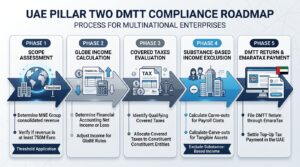
Phase 1: Scope confirmation and group mapping
Review consolidated accounts for the four preceding years against the €750 million threshold. List all UAE legal entities, branches, joint ventures and permanent establishments, and identify any Excluded Entities.
Phase 2: Data readiness and systems
Pillar Two needs data that standard accounting systems often do not track. Review your chart of accounts and reporting systems for items such as intragroup charges, tax and accounting depreciation differences, payroll by eligible personnel, deferred tax balances and dividend histories. Our accounting services in Dubai can help prepare the underlying records, and our audit services can support qualified financial statements.
Phase 3: Safe harbour modelling and forecasting
Test the transitional CbCR safe harbour and the full GloBE calculation well before the filing dates, so you can forecast cash tax and identify the entities that lower the UAE ETR.
Phase 4: Registration, filing and governance
Appoint the designated filing entity, register on EmaraTax, and set internal sign-off for the Information Return, the Top-up Tax Return and the payment.
Key compliance risks
1. Assuming that 9% tax is enough
An entity paying 9% faces a gap to 15%, subject to the SBIE and deferred tax adjustments. Provide for the top-up in your forecasts and cash management.
2. Relying on flawed CbC reporting data
The safe harbour works only if the underlying CbC report is qualified. Using management estimates instead of reconciled financial statements can invalidate the position and expose the group to the full GloBE calculation.
3. Transfer pricing weaknesses
GloBE rules require arm’s length treatment of intragroup transactions, and profit shifting into low-taxed UAE entities will be adjusted. Our UAE corporate tax guide explains the related Corporate Tax rules.
4. Joint and several liability
UAE members of the same domestic group are jointly and severally liable for the top-up tax. This matters in joint ventures and partly owned subsidiaries, so agree how the cost and responsibility are shared.
Do you need Pillar Two and DMTT advice?
Pillar Two combines domestic corporate tax, free zone rules, GloBE calculations and new filing obligations. Specialist advice can help with scope assessment, jurisdictional ETR modelling, qualified CbC reporting, registration on EmaraTax and the preparation of the Top-up Tax Return. Speak to our corporate tax consultants, or contact us to discuss your group.
Frequently asked questions
What is the revenue threshold for the UAE DMTT?
The DMTT applies to MNE groups with consolidated revenue of at least €750 million (about AED 3.15 billion) in at least two of the four preceding financial years.
How does the DMTT interact with the 9% UAE Corporate Tax?
Corporate Tax applies at 9% on taxable profits above AED 375,000. The DMTT works alongside it by testing the UAE jurisdictional ETR of in-scope groups. If the ETR is below 15%, the top-up tax brings it to 15%.
Are UAE free zone companies subject to the DMTT?
Yes, if they belong to an in-scope MNE group. A free zone entity that qualifies for 0% as a QFZP still counts in the UAE ETR, and top-up tax may apply.
When is the UAE top-up tax registration deadline?
Registration is reported as due within seven months after the end of the first in-scope financial year, with 30 November 2026 reported as the deadline for years ended before 30 April 2026. Confirm this in the FTA’s registration guidance.
What is the filing deadline for the DMTT return?
The Top-up Tax Return and payment are due within 15 months after the end of the fiscal year, or 18 months for the first transition year. For a calendar 2025 year, that is 30 June 2027.
What is the substance-based income exclusion (SBIE)?
The SBIE reduces net GloBE income before the top-up tax is calculated. It excludes a percentage of eligible UAE payroll costs and of the carrying value of eligible UAE tangible assets, at transitional rates that decline to 5%.
Can one entity file for all UAE group members?
Yes. A group can appoint a designated filing entity to register the UAE members, file the Top-up Tax Return and pay the tax. The other members remain jointly and severally liable.
Sources and Official References
- UAE Domestic Minimum Top-up Tax, UAE Ministry of Finance
- Pillar Two guidance document, UAE Ministry of Finance
- Cabinet Decision No. 142 of 2024 on the Imposition of Top-up Tax on Multinational Enterprises, UAE Cabinet
- Federal Decree-Law No. 60 of 2023 amending Federal Decree-Law No. 47 of 2022 on the Taxation of Corporations and Businesses
- FTA Top-up Tax guides and EmaraTax registration, Federal Tax Authority
Disclaimer: This content is provided for general informational purposes only and does not constitute tax or legal advice. Pillar Two rules, deadlines and guidance are complex and still developing. Please consult a qualified adviser before relying on this information.